■ DATE:
■ LOCATION:
■ CONCEPT AND REALIZATION:
■ ARTISTS:
■ SUPPORT:
■ FOLLOWING Q+A WITH THE FILMMAKERS:

![Lotte Schreiber, Filmstill aus „I. E. [site 01-isole eolie]“, 2004](https://goldenpixelcoop.com/wp-content/uploads/2025/12/LotteSchreiber_IE_03.jpg)


To take form at its word, or to make it visible through a cinematic process of translation. In her film language, Lotte Schreiber surveys an architectural reality without duplicating it. She approaches structuralist housing blocks in Trieste and on the outskirts of Rome, concrete skeletons in the winter landscape of Greece, the cabin town of Gänsehäufel in autumn, the Wittgenstein House, exhibition spaces, municipal housing estates and other social utopias of collective living. She enters these spaces and, at the same time, opens up new ones with her films. Political and historical contexts are revealed in layers.


Her formal language is clear and in direct exchange with her protagonists, which are mostly buildings and landscapes. The often static shots never appear rigid – even in a still image, wild movements occur within the structure of the rough film grain. Working across a variety of film and video formats, Schreiber never allows time to disappear into the material. Through unexpected ruptures in the montage, she repeatedly brings us back to the present, and thus into the cinema space.


TRT: 75 min.
After Lotte Schreiber’s and Sasha Pirker’s film “Exhibition Talks” was awarded the Diagonale Prize for Innovative Cinema in 2015, the two filmmakers created the festival trailer the following year. They took the form at its word.
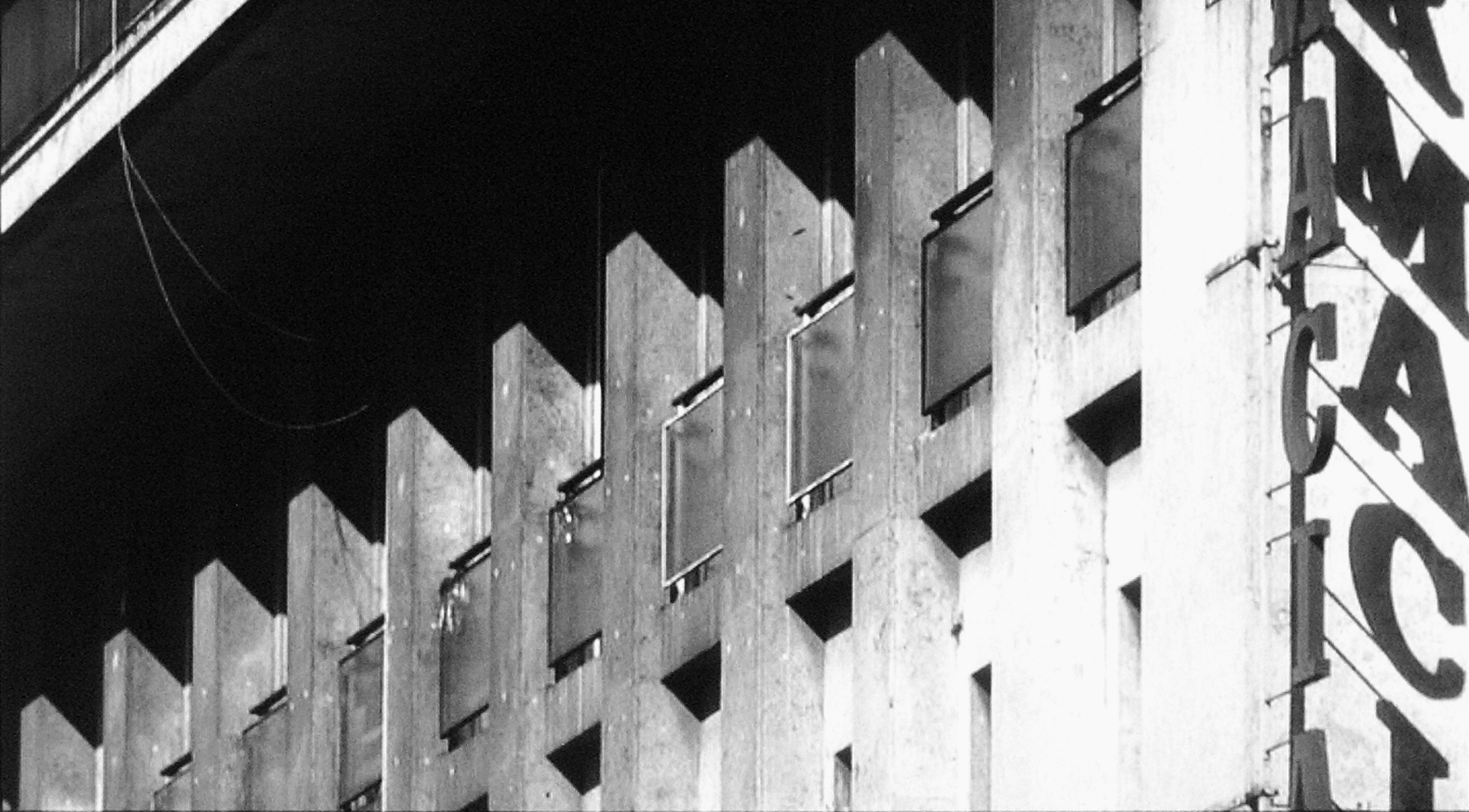
The title “Quadro” refers to the square floor plan of a monumental concrete structure in Trieste, Italy. In her cinematic portrait of this 1960s housing block, which embodies the contradiction between radical and failed ideas of modernism, Schreiber formulates many elements of her cinematic language for the first time. It also marks the beginning of a long-standing collaboration with experimental musician Stefan Németh (Innode), whose sound creates a deliberately raw, often very loud friction in dialogue with the images.
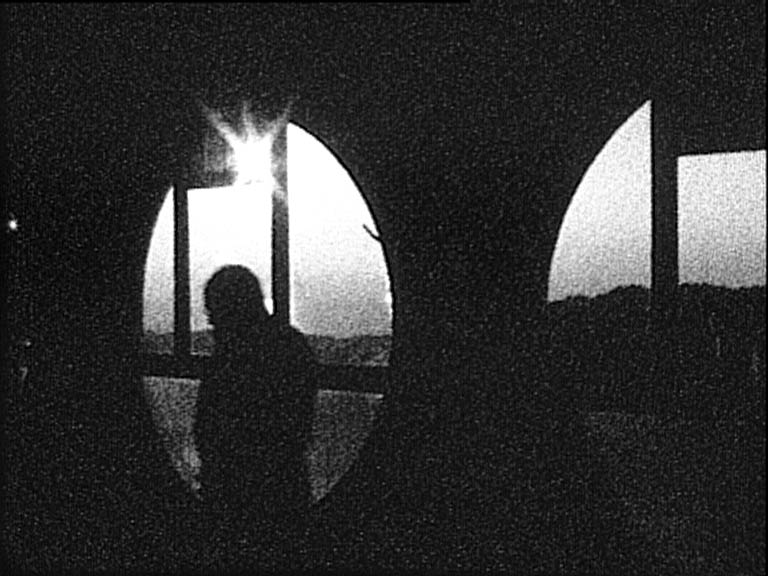
Clouds drift by, the sky trembles. Again and again, the static shots and their analog materiality are interrupted by shaky video recordings. These intense movements are created by an approaching, a forward motion, a physicality of the images. With heavy steps, over stones, through tall grass, along the sea, past fishermen. What’s this rumbling? At first we hear it from afar, then it comes closer and closer. It rumbles incessantly, in the landscape as well as in the framed images. Until it finally appears – smoking – the Stromboli.
Continuing her montage concept of disruption, the filmmaker takes us on a journey through the impressive and unusually wintry landscape of Greece. She documents many unfinished concrete structures that, like geometric foreign bodies or dystopian skeletons, stand scattered across the Peloponnese and Crete. Car and camera movements lead from one structure to the next, from one static image to the next. “Domino”, also referring to a concrete construction system designed by Le Corbusier, is the third part of Schreiber's “cinematic cartographies” after Quadro and “I. E. [site 01-isole eolie].”
“I've lost my sense of direction. The system is out of control,” we hear a voiceover from a phone. A middle-aged man in a suit and tie, carrying a briefcase and cell phone, trudges aimlessly through the area. We are at Gänsehäufel in Vienna, which is known as a popular recreation and outdoor swimming area, crowded with guests in summer. Now it is autumn: the wind has blown fallen leaves into piles, cabins and walking paths are empty, and the complex feels ghostly and eerily deserted. Who is the man speaking to, and to whom is he listening? We hear him, again and again, speaking in fragments, apologetic, accusatory, judgmental. Maybe these are his inner conflicts? While looking down from the bathing tower onto the architecture of this small cabin city, he appears to silently negotiate with himself. His tension transfers to the camera view, and, together with him, we recognize him like a reflection, as he passes by in the distance between the concrete blocks.
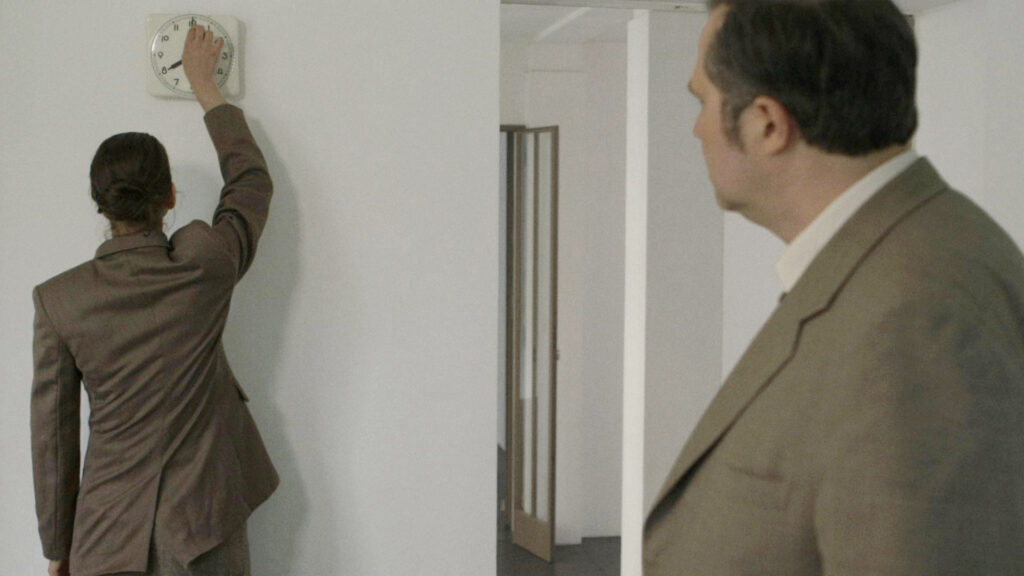
Four years had passed since “GHL”, but the protagonist appears to have walked into the Wittgenstein House straight from Gänsehäufel. Here, too, he seems lost. And while he’s lost, he observes other lost people scattered throughout the house. They follow a mysterious order and go about wonderfully absurd activities. He’s a little puzzled, but not overly so. An athlete climbs into the house on a ladder. A woman sorts beads according to an opaque system. There is also a chemical laboratory, a woman with glasses, a fitness trainer, and a man drawing circles. Another man scans the surface of a vase with a bamboo stick. Silence provokes the atmosphere, until we finally arrive at a sickbed with many flies. What language is spoken here? And what time is it, actually?
How can a statistical figure be made visible — especially when that figure represents people who have lost their lives while fleeing across the Mediterranean? With “If I Had Land Under My Feet”, Lotte Schreiber stages a performative act in public space and simultaneously translates it into a short film. 200 people position themselves in a grid on an empty street and disappear from the image, one after the other. Silent, terrifying and shockingly clear, Schreiber conveys the difference between presence and absence, contrasting an abstract mass with individual human beings.
TRT: 71 min.
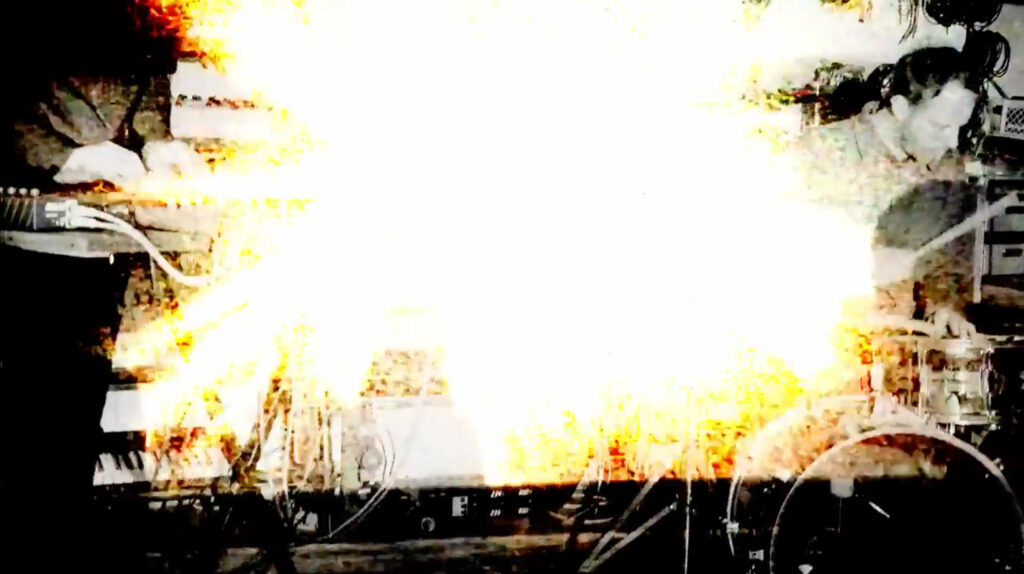
Los Angeles, 1996. A view through the windshield, shaky, endless highways, passing highway bridges, fragments of a Californian landscape. Super 8 footage from Schreiber’s personal archive is the starting point for this music video, interpreting the track “Air Liquide” from the album “Grain” by the band Innode. The images are cut up and rhythmically branched in the montage, superimposed and layered, crossfaded, enhanced with effects, and manipulated in time. In between, basketball courts, the sea, a rehearsal room, and other fleeting images are mixed in, coming together associatively like memories in an audio-visual composition.
Don Bosco is a neighborhood on the southeastern periphery of Rome. Planned under Mussolini, shaped by Fascism, built in the postwar period, and realized in the spirit of reconstruction and in the modernist style of the 1950s and 1960s. Affordable housing that, however, could not live up to its utopian promises in reality. Before Lotte Schreiber, Pier Paolo Pasolini with “Mamma Roma” and Federico Fellini with “La Dolce Vita” had also devoted their classic movies to this place, which she renders audible through quotations. Once again, Schreiber explores the relationship between architecture and film in this precise continuation of her “cinematic cartographies.”
“Normally the entrance is here. Normally,” explains the voice-over, as we see the empty exhibition spaces of the Tyrolean Architecture Forum. The rooms are framed in graphically composed images, and abstracted further by incident sunlight, shadows, patterns, details, and reflections. “But everything is possible, everything conceivable, everything doable.” In their film “Exhibition Talks”, Lotte Schreiber and Sasha Pirker approach the building through cinematic spaces of possibility and potential, and were awarded the Diagonale Prize for Innovative Cinema in 2015.
A young man smokes a cigarette. That’s exactly how long the film lasts. At the end, we hear a quote from Pasolini’s “Corsair Writings”, expressing Schreiber’s interest in overlaying an everyday action with a text about Fascism.
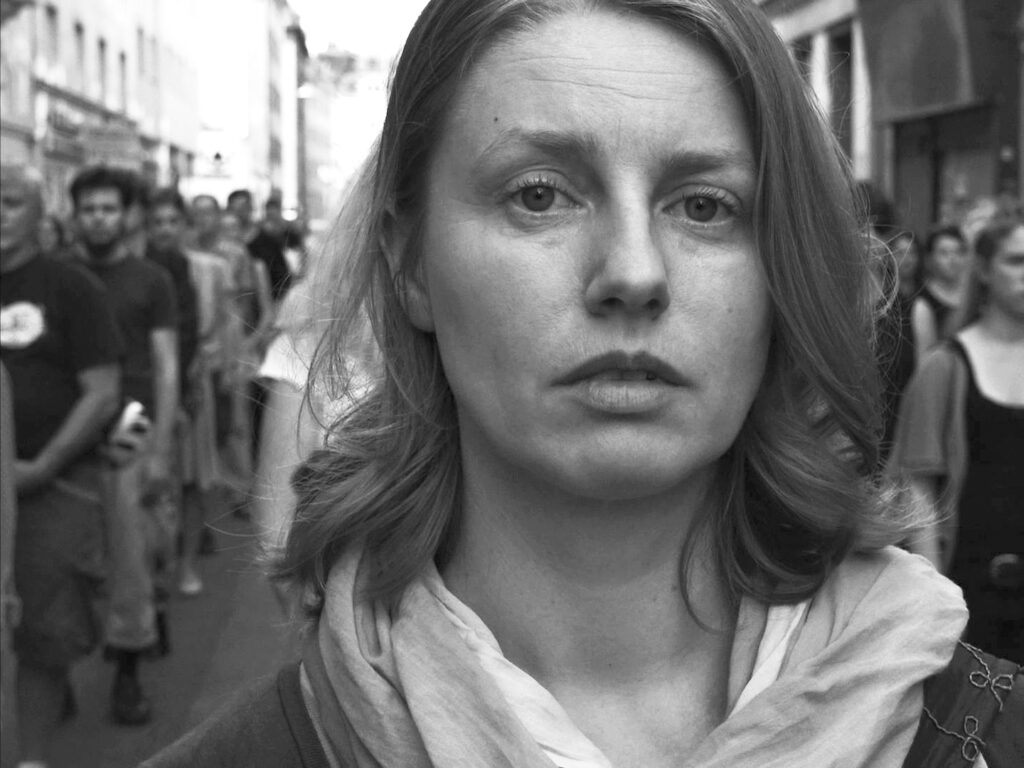
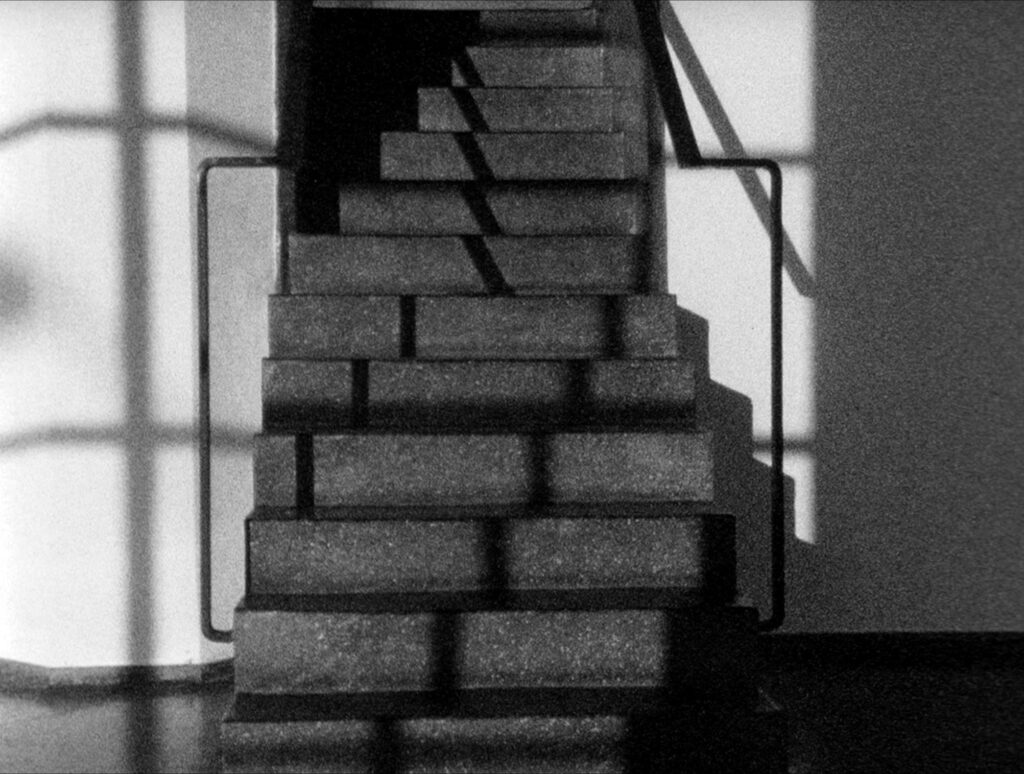
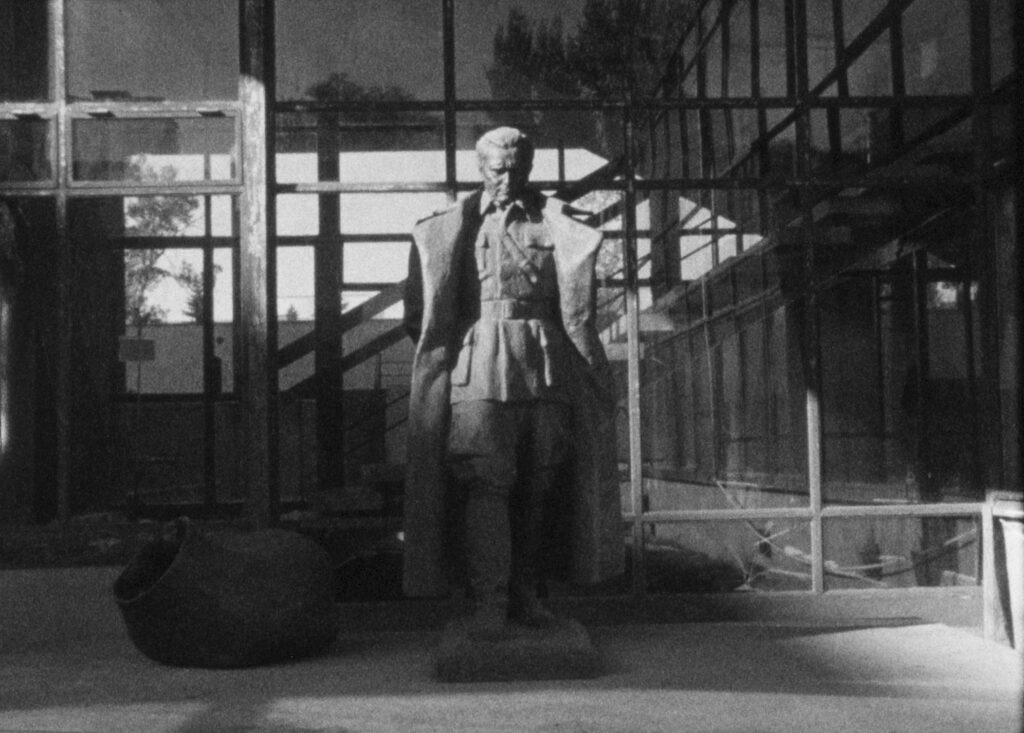
In “Some Memories”, we remember. The main protagonist is the “Historical Museum of Bosnia and Herzegovina” in Sarajevo, which commemorates the history of Yugoslav socialism. With it, museum director Elma Hašimbegović recalls its origins, tasks, and responsibilities, as well as the major cultural-political difficulties of the present. Through short portraits of the employees, the filmmaker recalls the people who continue to work at this institution, despite adversity. And on a formal level, we too remember because Lotte Schreiber's cinematic language consciously repeats and further develops established montage elements and material choices over the years and across her works.
Skateboarding, trampoline jumping, table tennis, and making films together. Lotte Schreiber spends a lot of time at the youth center of the municipal housing estate Hasenleiten in Vienna’s Simmering district. She documents the everyday lives of the young people with her camera and tells the eventful history of the estate using historical images and text panels. While hanging out in the park, the young people imagine their future. Will they meet here again in 10 years? They laugh in response.

Photo: © Maria Kracikova
Filmmaker and artist Lotte Schreiber lives in Vienna and works between cinema, art, architecture and society. Her experimental documentary films have screened at international film festivals (including the Oberhausen Short Film Festival, International Film Festival Rotterdam and Vision du Réel Nyon), her video installations and media works have been exhibited at numerous exhibitions (including the Neue Galerie Graz, Kunsthaus Graz, and NSK State Pavilion at the 57th Biennale di Venezia). 2019 con-tempus Award, 2017 State Scholarship for Video and Media Art, 2015 Diagonale Prize for Innovative Cinema (with Sasha Pirker), 2011 Outstanding Artist Award for Avant-Garde Film by BKA.
We use the font “Suisse Int’l,” which was kindly provided to us by Swiss Typefaces.